Introduction
Shipping software should be your team’s biggest competitive advantage — not the infrastructure holding it back. Yet for most engineering teams today, deploying to the cloud means wrestling with misconfigured pipelines, inconsistent environments, and manual processes that introduce both risk and delay. As companies scale their microservices on AWS, the gap between what DevOps promises and what teams actually experience grows wider.
In a world where speed-to-market defines survival, especially for cloud-native product companies and startups, slow deployments are not a technical inconvenience — they are a business liability. CTOs and founders are left managing infrastructure complexity instead of driving product innovation.
If you are responsible for engineering velocity, cloud costs, or deployment reliability, this article will show you how CloudLaunchPad eliminates the friction from DevOps — without sacrificing control or security.
Current Industry Situation
Most engineering teams start without a dedicated DevOps or platform engineering function. Developers manage deployments, infrastructure is configured as needed, and manual processes work well enough — until the product starts to scale.
As cloud environments become more complex, teams need strong Cloud infrastructure management to handle infrastructure, deployment pipelines, security controls, and operational workloads. The latest research shows that organizations are increasingly responding with platform engineering, automation and stronger cloud operations.
Here’s what leading research and consulting firms found:
[1] Gartner projects 85% of organizations with platform engineering teams will offer internal developer portals by 2028, up from 60% in 2025 — structured DevOps platforms are quickly becoming the norm, not the exception.
[2] McKinsey’s research on operational excellence found that integrating site reliability engineering (SRE) practices into how teams manage infrastructure and applications leads to meaningfully better outcomes than treating DevOps as an afterthought bolted onto engineering.
[3] Executives writing for Forbes flagged that even a well-planned DevOps initiative can quietly drift as a company scales, recreating the exact silos, inefficiencies, and bottlenecks it was originally meant to eliminate — proof that DevOps needs ongoing ownership, not a one-time setup.
If you are responsible for engineering velocity, cloud costs, or deployment reliability, this article will show you how CloudLaunchPad eliminates the friction from DevOps — without sacrificing control or security.
Most engineering teams launch without a dedicated DevOps engineer. It feels like a reasonable trade-off early on — developers handle deployments, infrastructure is cobbled together, and it works well enough. Until it doesn’t.
The moment your product scales, the absence of proper DevOps practices stops being a technical inconvenience and becomes a direct threat to revenue, reliability, and customer trust.
How CloudLaunchPad Simplifies DevOps
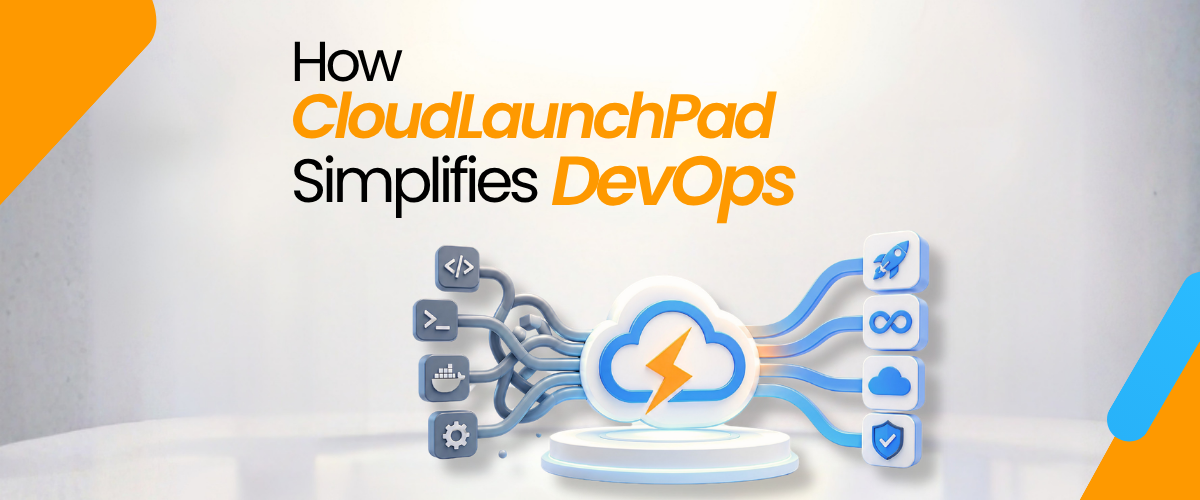
CloudLaunchPad is a self-service DevOps automation platform built specifically for AWS EKS and ECS environments. With built-in Kubernetes deployment automation, it abstracts infrastructure complexity without removing visibility, giving engineering teams a single pane of glass to launch, manage, and monitor microservices deployments.
Where Most Teams Lose Time (and How CLP Fixes It)
Problem 1: Inconsistent Environments Across Dev, Staging, and Production
A startup’s dev team pushes code that works perfectly locally, then breaks in staging because environment configs are manually maintained and drift over time. CLP enforces environment parity by design — every deployment uses standardised configuration templates, eliminating ‘it worked on my machine’ failures.
Problem 2: Manual Security Approval Gates Slowing Releases
Security reviews shouldn’t become a bottleneck—they should be built into the deployment process from day one. CloudLaunchPad shifts security left through robust CI/CD pipeline automation, embedding policy checks, IAM-based access controls, security validations, and compliance gates directly into the pipeline. Only authorized developers with the appropriate IAM permissions can deploy applications or make approved changes through the platform.
More importantly, environments are automated and standardized, minimizing direct server access and preventing uncontrolled manual configuration changes. This reduces configuration drift, human error, and unauthorized modifications while giving organizations centralized control over who can deploy, what can be changed, and how changes reach each environment. With CloudLaunchPad, security becomes a continuous, enforceable part of every deployment—not an approval step added at the end.
Problem 3: No Rollback Strategy Until Something Goes Wrong
Most teams think about rollback strategies only after an incident occurs, when every minute of downtime matters. CloudLaunchPad makes rollback readiness part of the deployment process by maintaining previous versions of your application containers. If a new release introduces an issue, teams can quickly revert to a known stable version instead of scrambling to rebuild or redeploy. This helps reduce recovery time, minimize downtime, and make deployments safer and more predictable.
Problem 4: Automation Alone Can’t Fix What Automation Didn’t Predict
This is where CloudLaunchPad goes beyond a traditional DevOps platform. We operate on a Software with a Service (SwaS) model—combining the power of automation with access to experienced DevOps professionals. You don’t just get a platform, documentation, or automated workflows; you get technology backed by real engineering expertise. When your pipeline fails, your Kubernetes cluster behaves unexpectedly, or a deployment needs expert intervention, our DevOps team is there to support you. CloudLaunchPad gives you the speed of software automation with the confidence of human expertise when you need it.
Real-Life Example
The Problem: Deployment Delays Killing Release Cadence
A B2B product company with a 12-person engineering team was shipping product updates once every three weeks. Their AWS EKS setup was configured manually, deployments required a senior engineer’s involvement every time, and they had experienced two production outages in six months due to environment mismatches.
What Changed After CloudLaunchPad:
- Deployment frequency increased from bi-weekly to daily within 45 days.
- Time-to-deploy dropped from an average of 47 minutes to under 14 minutes per release.
- The team eliminated two dedicated DevOps headcount costs, redirecting budget to product engineering.
- Zero production incidents in the 90 days following CloudLaunchPad implementation.
Industry Observation: This pattern is consistent across mid-market product teams. The bottleneck is rarely the code — it is the infrastructure layer between code and production. Teams that automate that layer consistently report 2–3x improvements in deployment frequency within the first quarter.
Key Takeaways
1. Slow deployments are a business problem, not just a technical one.
Infrastructure friction directly reduces your ability to compete, retain customers, and respond to the market.
2. Security and speed are not a trade-off.
The right platform embeds security into the deployment process — it does not bolt it on at the end.
3. Environment standardisation is the highest-leverage fix.
Most deployment failures trace back to environment inconsistency, not bad code — which is exactly why Automated software deployment across dev, staging, and production matters so much.
4. Human support is the missing layer.
Automation handles the vast majority of day-to-day operations. But incidents, edge cases, and unexpected failures still need human judgment — regardless of when they happen. CloudLaunchPad includes both.
5. Deployment automation compounds over time.
Teams that invest in pipeline automation early scale faster, hire smarter, and spend less on reactive infrastructure management.
Conclusion
DevOps was supposed to close the gap between development and operations. For most teams, it has instead added a new category of complexity. CloudLaunchPad was built to close that gap for real — giving engineering teams a platform that handles deployment automation, enforces security, standardises environments, and backs it all with human DevOps expertise.
Looking ahead, the teams that will scale fastest are not the ones with the largest infrastructure budgets — they are the ones that deploy most reliably. As AWS continues to expand EKS capabilities and AI-assisted DevOps tooling matures, the competitive advantage will belong to teams who have already automated their deployment foundation.
The question is not whether to simplify your DevOps. It is how fast you can get there.
Ready to Simplify Your DevOps?
If your team is spending more time managing infrastructure than shipping product, it is time for a conversation.
Schedule Your CloudLaunchPad Assessment
Get a personalised audit of your current AWS deployment setup, with specific recommendations to reduce deployment time, improve reliability, and cut unnecessary infrastructure overhead.
References
[1] https://www.cortex.io/post/cortex-recognized-again-as-a-representative-vendor-in-the-2025-gartner-market-guide-for-internal-developer-portals
[2] https://www.mckinsey.com/capabilities/tech-and-ai/our-insights/unlocking-cloud-value-achieving-operational-excellence-through-sre
[3] https://www.forbes.com/councils/forbestechcouncil/2026/07/01/clear-warning-signs-a-devops-initiative-is-losing-its-way/
Footer